By Dickson Bandera
VICTORIA FALLS — The expansion of air connectivity is emerging as one of the key drivers of Zimbabwe’s tourism recovery and growth, with increased airline capacity opening the country to more regional and international travellers while strengthening links between its major tourism and commercial centres.
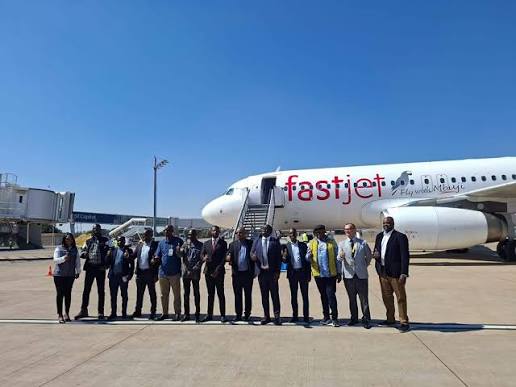
The latest development has come from fastjet Zimbabwe, which has introduced an Airbus A320-200 on a short-term lease to meet increased passenger demand during the August and September peak travel period.
The larger aircraft is being deployed primarily on the high-demand Harare–Johannesburg and Victoria Falls–Johannesburg routes, increasing capacity at a time when tourism, business and regional travel demand traditionally rises. fastjet says the A320 deployment is also being used to assess the aircraft type as a potential permanent addition to its fleet from 2027.
For Zimbabwe’s tourism industry, the development goes beyond the addition of an aircraft. It represents increased capacity on two important international gateways and provides greater opportunity for visitors to connect directly with Zimbabwe’s tourism products.
From Harare–Victoria Falls to a regional network
fastjet Zimbabwe’s story is closely linked to the development of Zimbabwe’s domestic and regional aviation market.
The airline began operations in Zimbabwe in October 2015, launching with a Harare–Victoria Falls service. Its inaugural flight on 28 October 2015 was operated by an Airbus A319 and was welcomed at Victoria Falls International Airport with a traditional water-cannon salute.
The choice of Victoria Falls as its first route was significant. The resort town is Zimbabwe’s flagship international tourism destination and one of the country’s principal gateways for visitors coming to experience the Victoria Falls, wildlife, adventure tourism and the wider Zambezi tourism circuit.
The airline subsequently expanded beyond its initial domestic operation.
In February 2016, fastjet launched its first international service from Zimbabwe, linking Harare and Johannesburg. The inaugural flight departed Harare on 1 February 2016, establishing a direct connection between Zimbabwe’s capital and South Africa’s major commercial and aviation hub.
A month later, in March 2016, fastjet extended its international network to include Victoria Falls–Johannesburg, creating an important direct air bridge between one of Southern Africa’s leading tourism destinations and Johannesburg.
The development of these routes has helped position aviation as an important component of Zimbabwe’s tourism value chain, connecting visitors with accommodation establishments, tour operators, attractions, conference facilities, restaurants, transport companies and other tourism businesses.
Aviation and tourism moving together
The relationship between aviation and tourism is particularly important for Zimbabwe, where long-distance international travellers often rely on regional hubs to reach the country’s major destinations.
Every additional seat into Zimbabwe therefore represents potential business for the wider tourism economy.
Improved air access can stimulate tourist arrivals, business travel, Meetings, Incentives, Conferences and Exhibitions (MICE), sports tourism, wildlife and nature tourism, cultural and heritage tourism and religious tourism.
For Victoria Falls in particular, stronger connectivity with Johannesburg provides an important link to one of Africa’s largest aviation and business markets.
The expansion also strengthens the potential for travellers to combine Zimbabwe with other destinations in the region, supporting the development of multi-destination tourism itineraries across Southern Africa.
A larger aircraft for a growing market
The introduction of the Airbus A320-200 is therefore significant not simply because it is a larger aircraft, but because fastjet is responding to demonstrated demand on some of its busiest routes.
The airline announced that the A320 would enter service from 1 August 2026 during the August–September peak period. According to fastjet, the aircraft will provide additional capacity while allowing the airline to evaluate the aircraft’s suitability for its longer-term fleet development strategy.
The move comes as fastjet continues to build its footprint in Zimbabwe and the region.
The airline currently connects Zimbabwe’s major cities, including Harare, Victoria Falls and Bulawayo, while also operating international services linking Zimbabwe with Johannesburg and the Kruger Mpumalanga area in South Africa.
fastjet says it has carried more than four million passengers since commencing operations and has established itself as a recognised African airline brand. In 2024, fastjet Zimbabwe achieved registration under the International Air Transport Association’s Operational Safety Audit (IOSA), reflecting compliance with internationally recognised operational and safety standards.
Supporting Vision 2030
The growth in aviation connectivity comes as Zimbabwe continues efforts to position tourism as a major contributor to economic growth under Vision 2030 and the National Development Strategy 2.
Speaking on behalf of the Minister of Tourism and Hospitality Industry, Hon. Barbara Rwodzi, Deputy Minister Hon. Tongai Mafidi Mnangagwa said the investment demonstrated growing confidence in Destination Zimbabwe and reflected the importance of modern transport infrastructure in supporting tourism development.
He said improved air access was making Zimbabwe more accessible to travellers while creating opportunities across the tourism value chain.
Tourism and aviation are intrinsically linked: an aircraft arriving in Zimbabwe brings not only passengers, but potential demand for hotels, lodges, tour operators, restaurants, transport providers, attractions, conference venues and local businesses.
The benefits can also extend into surrounding communities, particularly in tourism destinations such as Victoria Falls where visitor spending supports a broad ecosystem of formal and informal economic activity.
Strengthening Destination Zimbabwe
The expansion of fastjet’s capacity also comes at an important time for Zimbabwe’s tourism industry as the country continues to promote itself as a competitive destination in the regional and international market.
Government has reiterated its commitment to upgrading airport infrastructure, expanding air connectivity and working with the private sector on destination marketing and tourism development.
The country’s aviation network will be particularly important as Zimbabwe prepares to host Sanganai/Hlanganani Dzimbahwe World Tourism Expo 2026 in Masvingo, bringing together tourism buyers, exhibitors, destinations and industry stakeholders.
For the tourism sector, increased connectivity provides the infrastructure upon which destination marketing can be converted into actual arrivals.
A vote of confidence in Zimbabwe’s tourism future
From its first Harare–Victoria Falls flight in 2015 to the development of international routes and the deployment of a larger Airbus A320 during the 2026 peak season, fastjet’s Zimbabwe journey mirrors the growing importance of aviation in the country’s tourism economy.
The airline’s decision to test the A320 for possible longer-term deployment is particularly noteworthy. Should the trial lead to a permanent fleet addition, it could provide further capacity for Zimbabwe’s busiest regional markets and support continued growth in passenger volumes.
As Zimbabwe seeks to grow tourist arrivals, diversify tourism products and strengthen its position within the Southern African tourism market, the expansion of airline capacity provides an important link between the country’s attractions and the travellers who want to experience them.
The skies above Zimbabwe are, increasingly, becoming an important part of the country’s tourism story.